

September 3, 2026
The type 1 diabetes donor community is a powerhouse. Collectively, we generate hundreds of millions of dollars annually for diabetes nonprofits by hosting and participating in every kind of event imaginable, from classic walks, rides, and galas to competitive mahjong and pickleball tournaments. All of this is done to better the T1D community.
This financial support is essential. For the nonprofits that receive the proceeds, the money is what allows them to operate. For donors, it is a way to support the cause that matters deeply to them. For most of those donors, there is no more powerful promise than that their gift will help accelerate a cure for T1D. There is no stronger nonprofit fundraising message than a cure.
This is the fifteenth annual report comparing fundraising messaging with actual cure funding. Here we focus on the two largest and most influential diabetes nonprofits: Breakthrough T1D and the American Diabetes Association (ADA).
The most noticeable trend over the past several years has been a dramatic decrease in the use of the cure promise as the primary fundraising message. Both nonprofit organizations have shifted the focus of their fundraising messaging away from delivering a cure in favor of catch-all advertising that lists everything from advocacy and prevention to improving the day-to-day—before adding ‘cure.’
For many years, JDCA advocated that the cure promise as the main fundraising marketing message should more accurately reflect the actual use of funds. We had hoped that the cure promise would remain as the primary message while actual funding, of which only a small portion went to cure research, would be increased to match. However, the opposite has occurred.
Information in this report was gathered from a comprehensive review of both organizations’ 2026 US event calendars, as well as Breakthrough T1D’s and the ADA’s publicly available FY25 financial statements.
Fundraising Overview: Events vs. Actual Allocation
Breakthrough T1D
- 277 national fundraising events will be held in 2026.
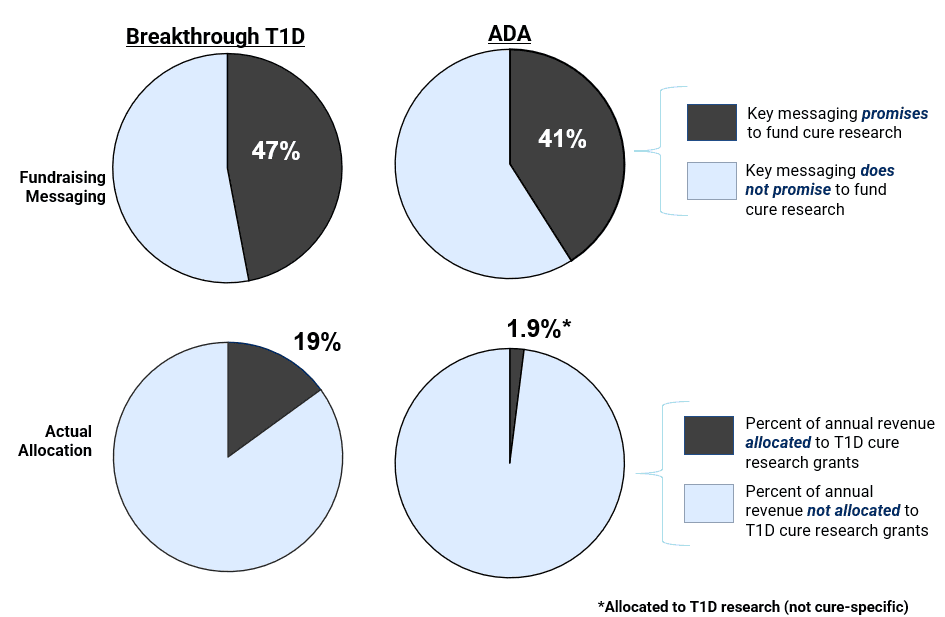
- 47% used a cure-focused message (see chart A).
- 19% of revenue went to new cure research grants (contracted).
American Diabetes Association
- 34 national fundraising events will be held in 2026.
- 41% used cure-focused messaging.
- 2% of revenue was spent on unspecified T1D-specific research (cure-specific research is likely much less).
Decline of the Use of the Cure Promise in Fundraising
Before 2023, diabetes nonprofits honed their advertising to focus on what donors value most: A cure for T1D. Then the shift began. The ‘cure’ as the main promise declined in use, but the value and importance of a cure to people in the T1D community has not changed.
In 2026, 96% of surveyed community donors said cure research should be the top priority for diabetes charities. There is no greater rallying cry to inspire community support; nothing else is as important.
Breakthrough T1D
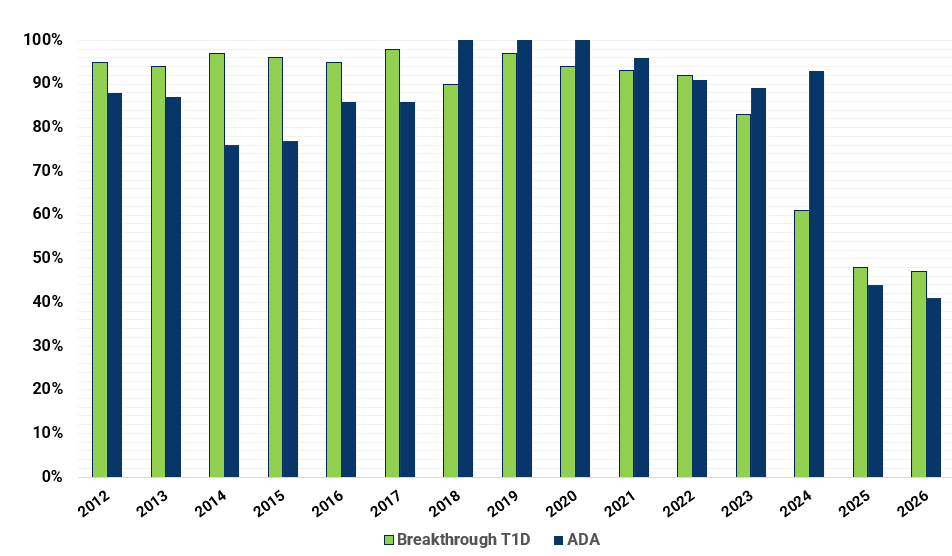
From 2012 (JDCA’s first year tracking this data) to 2023, an average of 94% of Breakthrough T1D’s fundraising event advertising messaging used the promise of a cure as its core message. Starting in 2024, the year JDRF rebranded to Breakthrough T1D, the cure messaging focus dropped to 61% and continued to decline to 47% today (see chart B).
The Breakthrough T1D Walk series fundraising events (131 such events in 2026) use language that focuses on improving lives in a variety of areas on the way to a cure: “Join the largest type 1 diabetes (T1D) walk and the movement to transform life with T1D” and “Every step powers research, advocacy, and support to improve lives while driving toward cures.” The promise of a cure has been relegated to the end of a long list.
On the other hand, some event series, such as the Breakthrough T1D Ride, remain inherently cure-focused. A typical description reads: “More than cycling, it's a movement to cure type 1 diabetes (T1D).”
American Diabetes Association
There was a similar decline in the ADA's cure-focused messaging. From 2012 to 2024, an average of 90% of ADA’s fundraising events used a cure as the driving message. Within the last two years, the use of the cure promise fell dramatically, from 93% in 2024 to 48% in 2025.
ADA’s events fall into two main categories: The Step Out Walk (formerly the Step Out Walk to Stop Diabetes) series and the Tour de Cure rides. The Step Out Walk series (18 in 2026) now uses a generalized message, with language suggesting a handful of other areas take precedence: “This event increases awareness, connects communities, contributes to diabetes prevention and management, and supports the ADA’s vision of a life free of diabetes and all its burdens.”
On the other hand, the Tour de Cure rides (14 in 2026) remain inherently cure-focused. Cure is in the name.
Chart B: Percentage of Cure-Focused Messaging in Fundraising Events (Historical)
What Does This Mean Moving Forward?
Since JDCA began this report series in 2012, our consistent message has been that the cure promise should go hand-in-hand with cure funding. We hoped that the amount of money supporting cure research would rise to match that level.
However, what has actually occurred is that the cure promise has been reduced while cure research grants remain a minority. The alignment we were hoping for went in the wrong direction.
Despite the shift, the crux of the issue remains: Not enough focus, resources, or attention is placed on cure research. If someone gives to a chronic disease-focused charity, the expectation is that those funds will go to alleviating the disease for good. A cure is the most important outcome for those living with T1D today. Moving forward, we want to see a shift in the other direction, with cure funding rising to meet the cure promise, not the other way around.
If you donate to a diabetes-focused charity, stipulate that your donations go to cure research. If you do this in writing, organizations are legally obligated to put your money where you want it to go.
