July 30, 2026
This report reviews research grants contracted by Breakthrough T1D during the 2025 fiscal year (FY25). Breakthrough T1D is the world’s leading T1D-focused nonprofit, annually contributing millions of dollars to research grants each year. A close review of these grants allows us to see which research areas the organization is prioritizing now, and which are being deprioritized. In essence, it breaks down what research your donations are likely funding.
JDCA staff categorized each new research grant contracted during the last fiscal year (July 1, 2024 – June 30, 2025). ‘Contracted’ refers to the total amount committed in FY25 to be allocated over several years. This is different from actual grant spending, which was reported earlier this month.
In total, 154 research grants were contracted during the last fiscal year, an increase of 24 versus the prior year. The total amount to be distributed increased by 30%, from $92 million in FY24 to $120 million in FY25.
These grants do not include equity investments made by the T1D Fund. Grants are money given to researchers without an expectation of financial return. Comparatively, the T1D Fund receives stock in return for its investments.
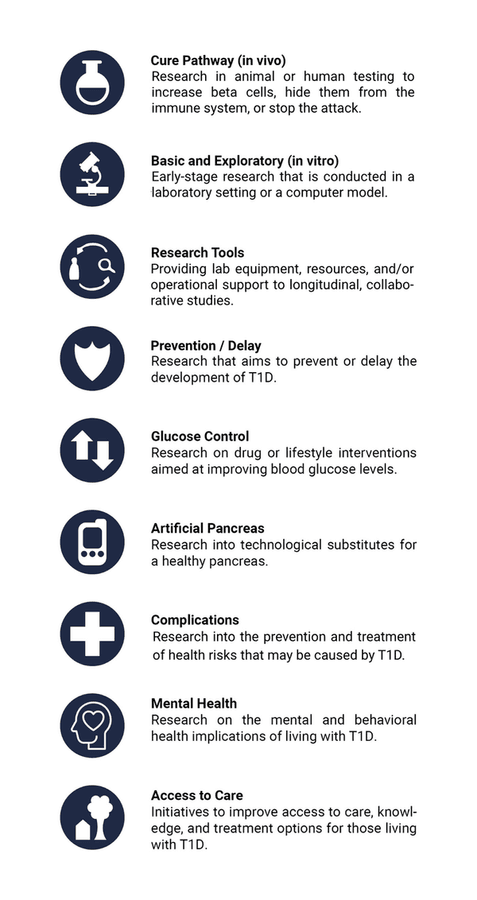
Breakthrough T1D grants are available for public view in its grant center database. Grants were categorized using specific JDCA definitions (see Appendix A), which differ from the broader terms used by Breakthrough T1D.
Research Grant Priorities by Category
Cure Pathway Reclaims the Top Spot
In this analysis, we use a broader definition of ‘cure pathway’ than the ‘Practical Cure’ definition that guides other reporting. Cure pathway includes research conducted in a living subject—humans, or more commonly, animals—that addresses at least one component of a T1D Practical Cure. A Practical Cure must offer a full solution for insulin independence and be in clinical trials today. Cure pathway captures earlier research that may contribute to a full solution in the future.
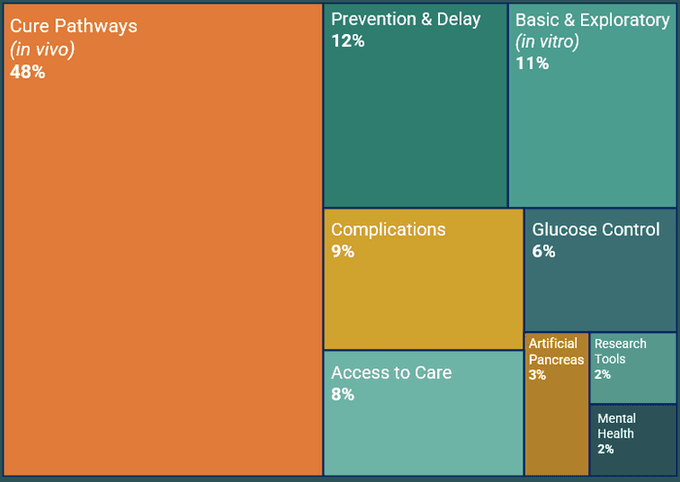
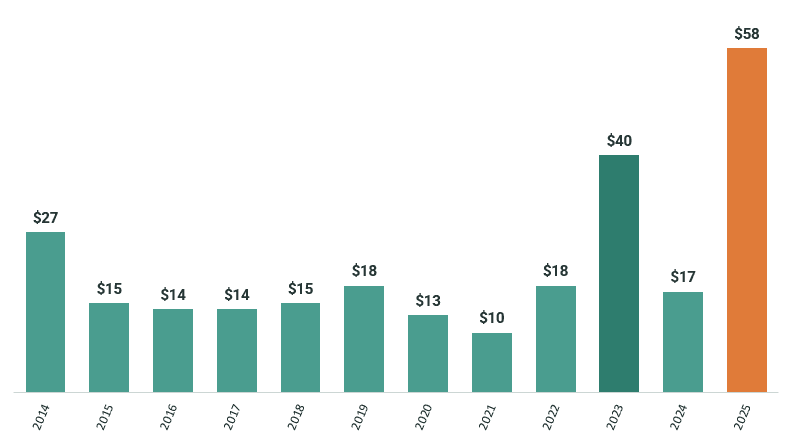
The category received $58 million in 51 contracted grants, or 48% of all promised funding. Compared to FY24, the number of cure pathway grants increased from 30 to 51. This is the largest monetary commitment to this category since JDCA began tracking this data in 2014.
Cure pathway grant funding has fluctuated greatly since FY22 (see chart B). The recent FY25 growth is noteworthy, aligned with what the T1D community has been asking for. It would be great if this growth were sustained. But if it is only a one-off that drops to lower levels in subsequent years, the metric will be short-lived. Now that cure research seems to have returned as the priority with heightened focus, we do not want the organization to lose momentum.
Chart B: Historical Cure Pathway Funding (Millions)
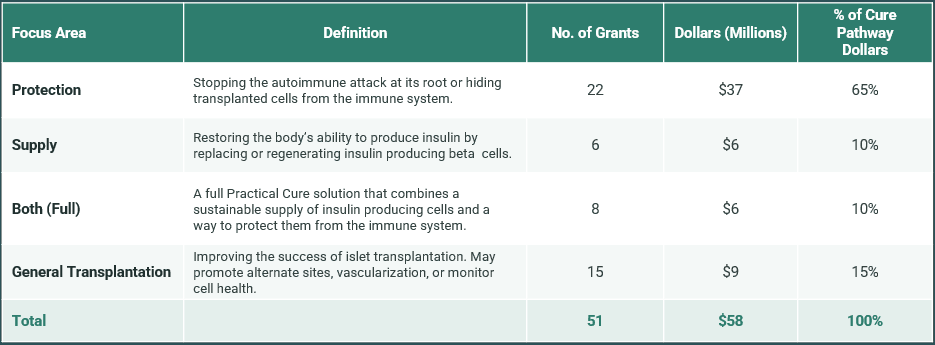
Cure Pathway Grants by Focus Area
Chart C: Breakthrough T1D FY25 Cure Pathway Category Focus
Full Cure Pathway Projects
Eight projects test full solutions to restore and protect insulin-producing cells. All are currently in animal models. Half are investigating stem cell-derived beta cells, gene-edited to be invisible to the immune system. Collectively, these projects received nearly $6 million in contracted funding in FY25.
The largest grant, totaling $1.5 million, went to the Jackson Laboratory in Maine. The project aims to use gene editing to create stem cell-derived beta cells camouflaged from the immune system and avoid rejection when transplanted. It is the only grant testing a full solution totaling over $1 million.
Other Pathways
Prevention & Delay: 12%
Prevention & delay fell to second priority in FY25. Funding decreased 40% from FY24, from $25 million to $15 million. The number of grants was slashed by over half, from 42 contracted in FY24 to 20 in FY25. Though this category has dropped recently in priority, a long-term funding cut is not expected. T1D researchers, nonprofits, and government entities continue to reinforce focus on screening, assessing risks for, and delaying the onset of T1D.
Basic & Exploratory: 11%
Basic & exploratory research was the third priority in FY25. It is a wider-ranging research category that encompasses the earliest stages of research (in vitro). Here, researchers are testing their earliest theories, simulating drug reactions in assays and petri dishes, and gauging early efficacy in simulations. In FY25, this category received 35 grants, an increase of 15 from the prior year. Total contracted funding rose accordingly, from $10 million to $14 million, an increase of 40%.
Other Changes
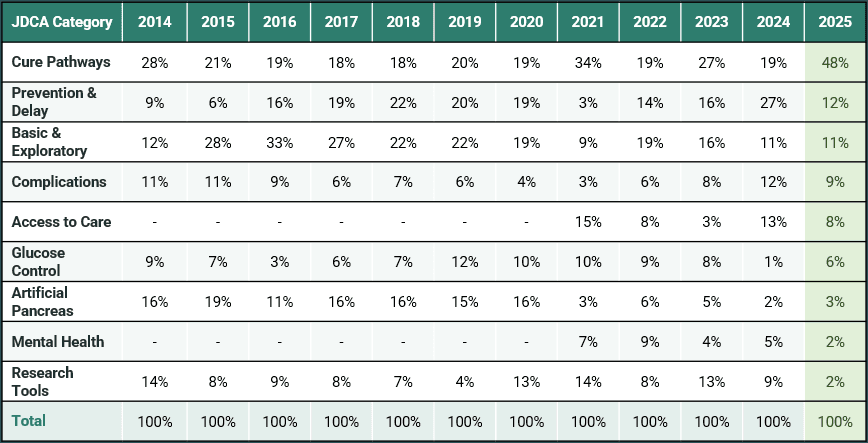
All other research categories individually received less than 10% of all contracted grant funding. Most experienced a decline in funding from FY24, with few exceptions (see Appendix B).
Complications totaled 9% of contracted grant funding and received a similar amount to last year. Glucose control (6%) saw a dramatic increase of 600% funding, from $1 million in FY24 to $7 million in FY25. Access to care decreased from $12 million to $9 million, 8% of total funding. Artificial pancreas stands similar to last year at 3%. Research tools and mental health were the lowest priorities, totaling 2% ($2 million) of all contracted grants and seeing a 75% and 60% drop in funding from the prior year, respectively.
The Five Biggest Grants
The five largest grants of FY25 are detailed below. In total, they are set to receive $32 million—27% of all contracted funding.
- $16 million (Cure Pathway): To the University of Massachusetts Medical School. Research aims to protect transplanted beta cells from the immune system using gene editing and novel drugs.
- $9 million (Cure Pathway): To the University of Chicago. This will support clinical testing of tegoprubart in protecting transplanted islets in those with T1D and chronic kidney disease. Note: Tegoprubart could offer cell protection but will not be considered a Practical Cure unless tested without immunosuppressive drugs.
- $3 million (Complications): To the University of Michigan (Matthias Kretzler), totaling 2% of total contracted grants. This will support the launch of a T1D precision medicine platform to prevent, treat, and reverse cardio-renal complications.
- $2 million (Prevention & Delay): To the University of British Columbia (Jan Dutz), totaling 2% of total contracted grants. This will test the safety of a psoriasis drug in preventing beta cell loss in new-onset T1D.
- $2 million (Cure Pathway): Boston Children’s Hospital (Robert Langer), totaling 2% of total contracted grants. This will support the creation of a wireless, oxygen-generating device to protect and support long-term islet transplantation.
The Five Biggest Recipients
The five institutions to receive the most funding are detailed below. Collectively, this amounts to nearly $39 million, or 32% of total contracted funding for FY25.
- $17 million - University of Massachusetts Medical School: Two cure pathway grants to protect beta cells from the immune system.
- $10 million - The University of Chicago: Two grants to support protection-based cure pathways, one grant to prevent/delay T1D, and one basic & exploratory grant to uncover peptides that trigger autoimmunity.
- $4 million - Regents of the University of Michigan: Three grants supporting complications research, and one grant supporting general cure pathway research.
- $4 million - The University of British Columbia: One grant to delay T1D progression, two in vitro basic & exploratory grants profiling and imaging beta cells, and one general transplantation cure pathway grant.
- $3 million - Boston Children's Hospital: Two cure pathway grants to support general transplantation and protect beta cells.
Academic vs. Commercial Grants
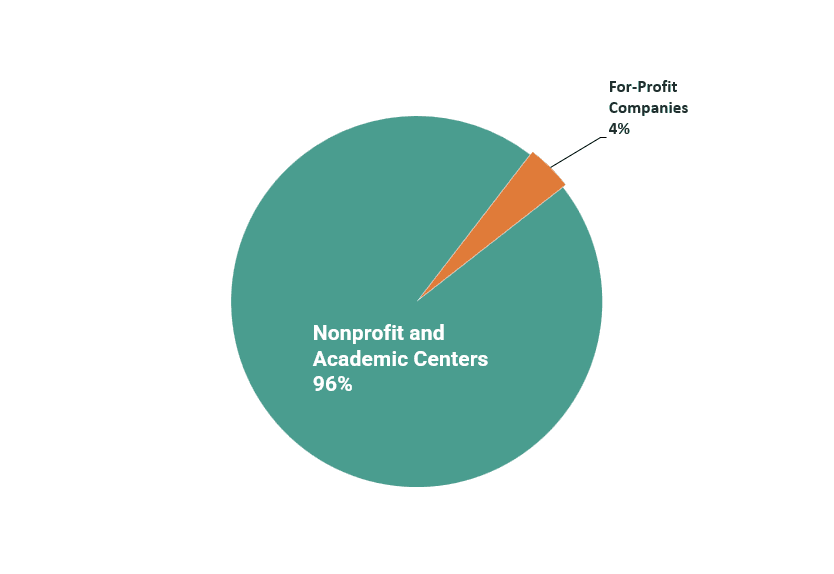
As in prior years, the majority of contracted grants went to academic institutions. Of 154 grants, only 17 went to for-profit entities. Commercial funding totaled $5 million, or 4% of total FY25 grants (see chart D).
The largest commercial grant, totaling nearly $800 thousand, went to Vector Psychometric Group to develop T1D patient-reported outcome measures. Vector is based in North Carolina and focuses on psychometric, statistical, and data collection to measure health, behavior, and educational development and modeling.
Chart D: Nonprofit vs. For-Profit Grant Allocation (Percentage)
Appendix A: JDCA Grant Category Definitions
Appendix B: Breakthrough T1D Categorical Research Grant Trends (as a Percentage of Total Funding)