
October 14, 2026
Today is Stem Cell Awareness Day. First celebrated in 2009, it is held annually on the second Wednesday of October to recognize the unique opportunities stem cells offer to treat disease. In this report, we use this day to examine stem cells’ potential to help achieve a functional cure for type 1 diabetes.
The potential applications of stem cells for T1D address both cell supply and cell protection. News today primarily highlights solutions for cell supply, where most research is directed, and clinical testing has shown results. A smaller application of stem cells for T1D aims to protect insulin-producing cells from the autoimmune attack. Compared with cell supply, this work is early stage, and much of it targets delaying T1D rather than a functional cure for established T1D.
To date, no stem cell-based treatment for T1D has been approved by the FDA.
Stem Cells 101
The use of stem cells for medical solutions ramped up slowly, then accelerated rapidly in recent years. The concept of ‘stem cells’ was first theorized by German biologist Ernst Haeckel in the late 1800s, but their existence was not definitively proven until a century later. Over the past twenty years, stem cell applications in medical research have expanded dramatically as a potential solution to many complex diseases. Several stem cell therapies have been approved to treat diseases, most notably blood cancers, immunodeficiencies, and genetic disorders.
For T1D, scientists began actively exploring stem cells as a treatment in the late 1990s:
- 1998: James Thomson, a University of Wisconsin biologist, isolated human embryonic stem cells (ESCs) for the first time.
- 2000: Researchers published the first study showing that insulin-producing beta cells generated from ESCs could normalize blood sugar in diabetic mice.
- 2014: ViaCyte initiated the first trial testing stem cell-derived beta cells (sBCs) in humans.
- 2021: ViaCyte published peer-reviewed data demonstrating sBCs could survive and produce insulin in humans.
- 2022-2025: Massive increase witnessed in use of stem cells for T1D by both academic research centers and, more recently, for-profit companies.
Stem Cell Types Used for T1D
- Embryonic stem cells (ESC): Derived from human zygotes three to five days after fertilization, these can mature into any cell type and be replicated indefinitely.
- Induced pluripotent stem cells (iPSCs): Adult stem cells that have had the hands of time rewound into an earlier, unmapped state. These can become any cell type and be replicated indefinitely.
- Adult stem cells (ASCs): Adult tissue found in specific areas of the body. These cells are multipotent, meaning they can mature into specific cell types but cannot be replicated indefinitely.
Cell Supply Solutions
Stem cell-derived beta cells are being used to replace those destroyed in the T1D autoimmune attack. These cells can be manufactured and produced at scale.
A handful of companies have an sBC solution in human trials today, with many more in preclinical testing. Six companies and one academic organization are testing cell lines in human trials, all of which use full-body immunosuppression (see chart A).
The most advanced product is Vertex Pharmaceuticals’ VX-880 (Zimislecel), in phase III clinical trials, which has achieved insulin independence (with broad immunosuppression) in ten individuals with A/AB blood type. A new trial, VX-017, recently began that hopes to be universally accepted by all blood types. Both trials will need to be paired with an autoimmune-protection solution to become a functional cure.
Chart A: sBC Treatments for T1D in Clinical Trials
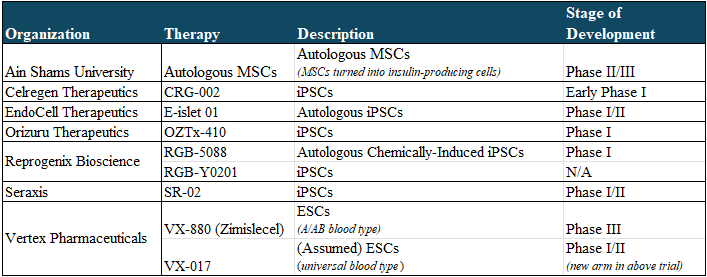
*Autologous - cells that come from the same person to later receive them. All other cell types come from another human.
Cell Protection Solutions
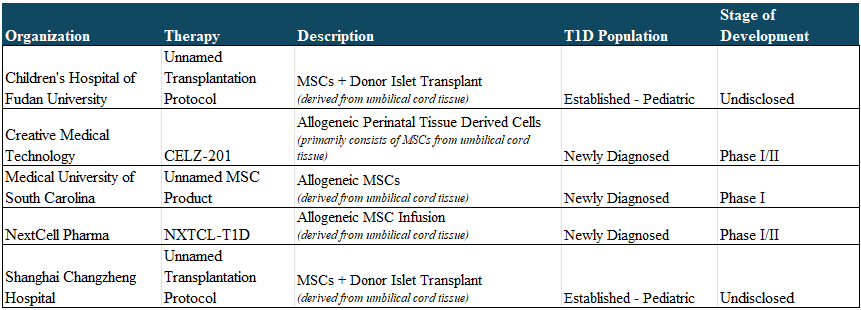
The most developed stem cell protection approach uses a specific type of adult stem cell called a mesenchymal stem cell (MSC). These aim to stop the autoimmune attack by reducing inflammation, calming immune cells, and supporting tissue repair. They are tested in two primary ways: (1) injected alone as a way to calm the autoimmune attack in earlier stages of the disease, and (2) transplanted alongside islets as both a form of protection and to boost cell health.
Most MSC treatments target newly diagnosed patients as a stand-alone infusion, but there is growing interest in co-transplanting MSCs with beta cells in fully established T1D. However, it is unclear whether this approach alone can provide enough support to protect islets or transplanted sBCs.
Chart B: MSC Treatments for T1D in Clinical Trials
Less Common / Long-Shot Approaches
There are a few other approaches utilizing stem cells that are farther away in development:
- Mixed Chimerism (Immune Reset): Use of donor blood-forming stem cells combined with donor islets aims to teach the immune system to ‘tolerate’ transplanted beta cells. To do this, induction drugs must wipe the immune system clean, which carries substantial risk.
- Stem Cell-Derived Tregs (Protect Islets): Tregs, a ‘good’ type of immune cell, travel to the site of beta cell destruction to protect them from the autoimmune attack. Derived from stem cells, they could be an off-the-shelf therapy if successful. Not yet in clinical testing.
- Stem Cell Educator (Protect + Regenerate Islets): A person’s white blood cells pass through a device coated in cord-blood-derived stem cells, hoping to teach the immune system to tolerate and regenerate beta cells. This therapy has been tested for over two decades with limited results that are, overall, not encouraging.
Outlook
The most important task in the years ahead is to develop a solution that combines both cell supply and cell protection in a format available to the broad population. Stem cell research—sBCs in particular—is likely to be an essential component of any such solution.
Although the potential is clearly visible—a light at the end of a long tunnel—there is still much work that needs to be done. We are encouraged by the continued work on these problems by many academic research centers and by the recent entrance of dozens of for-profit entrepreneurial companies working to crack the problem. With deliberate and disciplined focus and capital allocation, we expect to see many new projects enter human trials in the years ahead. But we must keep our eyes on the ball.
