
At a Glance
- 2,000+ abstracts were presented at the ADA’s 86th Scientific Sessions, held June 5-8.
- Roughly 19% of presentations focused solely on T1D; the majority (76%) focused solely or partly on T2D.
- Obesity remains the most discussed topic, with increasing attention on obesity as a standalone topic, outside of diabetes.
- Regarding Practical Cure progress, there was very little new news. Unlike prior years, where breakout clinical results for stem cell-derived beta cells and gene editing were shared, this year was relatively quiet.
- The most noteworthy news discussed the potential of tegoprubart, but the current trial is not a Practical Cure—it uses cadaveric cells and additional immunosuppressive drugs.
June 11, 2026
Monday marked the end of the American Diabetes Association’s (ADA) 86th Scientific Session. The Sessions were held in New Orleans, LA, from June 5-8. The Scientific Sessions are among the most anticipated diabetes conferences of the year. Diabetes researchers, scientists, and physicians worldwide meet to present and discuss the latest developments in diabetes research.
This report provides an overview of the convention's main themes and the top news related to T1D.
Over 2,000 presentations were showcased, covering all forms of diabetes. This year, as in prior years, most of the focus was squarely on type 2 diabetes. Only 19% of presentations focused solely on T1D.
Topic Breakdown: T1D Takes Backseat to T2D (Again)
JDCA analysts combed through posted abstracts and categorized each one by the lead focus. The main finding is consistent with prior years: T2D was the main focus, with 60% of presentations relating to T2D.
By the numbers:
- 60% focused on T2D.
- 19% focused on T1D.
- 16% held dual T1D and T2D focus (complications, diabetes technology, diabetes distress, etc.).
- 5% on other research (technology for other disease areas, MODY, insulinoma, PCOS, etc.).
T1D Highlights
This section will discuss the biggest T1D cure news from the Sessions. Highlighted are three presentations that received substantial discussion and/or are related to active Practical Cure projects.
However, perhaps the biggest story from the conference regarding T1D cure progress is the distinct lack of breakout results. Unlike the Sessions of prior years, there were no blockbuster results shared that marked a quantum leap forward along a cure pathway, such as presentations on stem cell-derived beta cell survival or gene-editing successes. Innovation leaders like Vertex and Sana did not present this year.
But, there were many work-in-progress presentations delivered on these and other T1D topics, which could lead to breakthroughs in the future. When the results were shared, they were interim or in an early model. Plans and next steps were also shared and discussed. Even though there were no groundbreaking cure results, much work and progress are underway, hopefully laying the groundwork for giant steps forward in the next few years.
That said, there are three T1D presentations that stand out: Two for the broad attention they received, and one because it has been identified as a potential Practical Cure project.
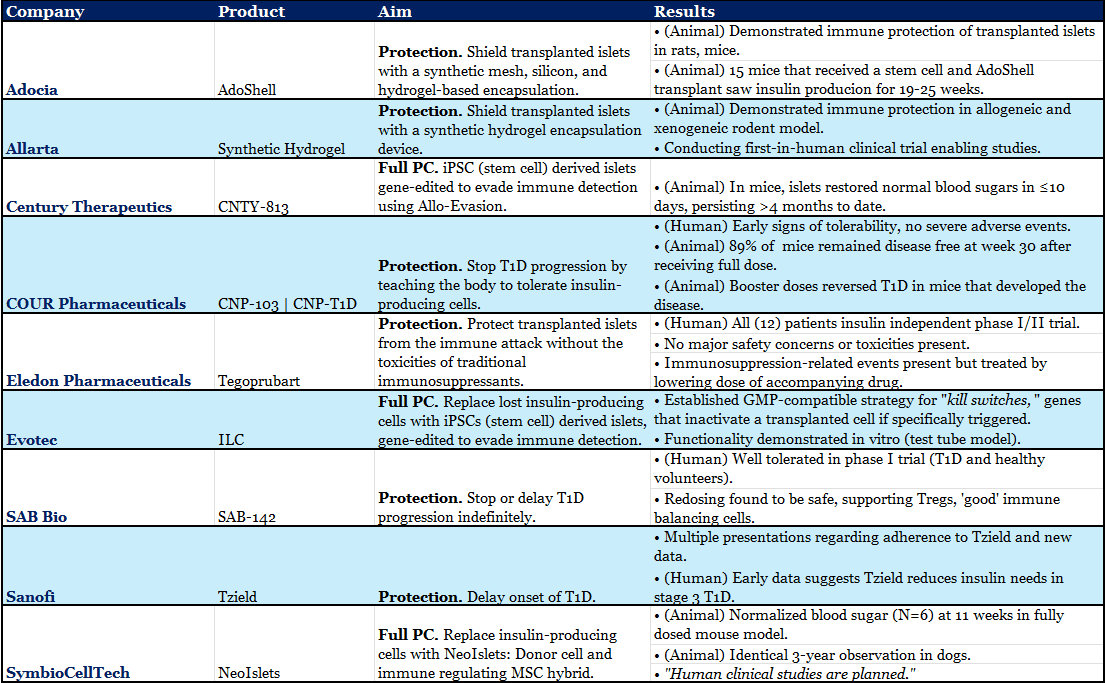
Lastly, several companies that JDCA tracks regularly presented at the conference. A quick summary of their presentations is in Appendix A.
1. Eledon Pharmaceuticals: Tegoprubart
Eledon released updated data from its phase I/II clinical trial testing Tegoprubart, a lab-made protein designed to protect insulin-producing cells from immune attack without the toxicities of traditional immunosuppression. The current trial is not a Practical Cure because it uses cadaver-sourced cells and includes additional immunosuppressive drugs.
The company has stated that it will begin a new trial in 2027 in collaboration with NewcelX, combining stem cell-derived beta cells alongside tegoprubart to provide cell protection. This would be a Practical Cure, and we are excited to see the trial start.
Highlights from the current trial:
- All patients (12) achieved insulin independence.
- The mean HbA1C for all patients was approximately 5%.
- No hypoglycemic events, rejection episodes, or antibodies against donor cells were reported.
- No evidence of nephrotoxicity, hypertension, or neurotoxicity was observed.
- Adverse events were treated by lowering the dose of an accompanying immunosuppressant.
2. Tzield: Improved Control Post-T1D Onset
Sanofi conducted several presentations at the Sessions for Tzield, the first disease-modifying therapy FDA-approved to delay the onset of stage 3 T1D. These presentations shared results from ongoing testing of the therapy.
In total, 35 patients with stage 2 T1D were followed for 2 years.
- 1 year: 84% of patients remained disease-free.
- 2 years: 57% of patients remained disease-free.
- In those who progressed to stage 3, daily insulin needs remained low, and both time in range and HbA1C were within clinical guidelines.
These early findings suggest Tzield could be used to reduce insulin needs for improved glycemic control.
3. BCG: Phase II Results (A Practical Cure Project)
Faustman Lab presented updates on two trials: One with adults who were diagnosed when they were children and one for LADA. BCG (Bacillus Calmette–Guérin) is a vaccine traditionally used for tuberculosis, but it is being tested in T1D to stop the immune attack and regenerate latent beta cells. Results were mixed.
Juvenile-Onset T1D Trial
The trial enrolled 58 participants. All participants were adults diagnosed before age 21 who had been living with T1D for at least 2 years. The results shared reflect at least 5 years of data.
- C-peptide levels did not improve at year five.
- Some saw an 184% improvement over the baseline of time spent with normal blood sugars.
- Many patients were able to reduce insulin; none are insulin independent.
LADA Trial (Latent Autoimmune Diabetes of Adults)
This trial had 95 participants. All participants were LADA and had fully established diabetes.
- No significant HbA1C reduction.
- Claimed to improve insulin resistance, restore stimulated C-peptide, and decrease diabetes autoantibodies.
Most Discussed Topics: Obesity, GLP-1s, Disease Management
Obesity
Obesity-related topics were the most discussed at the sessions. This included screening, prevention, therapies, risk factors, and complications. Over the past several years, coverage of obesity at the Sessions has steadily grown. This growth in importance is not surprising, as approximately 42% of US adults are considered obese. The ADA has put growing emphasis on obesity, providing a 2026 update to its Standards of Care in Overweight and Obesity.
GLP-1s and SGLT2 Inhibitors
The number of presentations focused on GLP-1s and SGLT2 inhibitors was similar to last year. Both are well-known as T2D medications that lower blood sugar and lead to weight loss, becoming increasingly popular. Topics addressed:
- The use of GLP-1s, both to lower blood glucose and as a weight management option, was discussed for all forms of diabetes.
- Both drugs are being explored in adult and pediatric populations.
- Sarcopenia, the loss of muscle mass, was a common topic. Current anti-obesity and blood sugar-lowering medications are known to have muscle loss as a side effect, prompting research for alternative therapies.
Management: Technology, Complications, Diabetes Distress
Increasing emphasis is being placed on monitoring and improving diabetes management in all populations. Additionally, significant attention was brought to the distress levels of caregivers of T1D children, as well as the distress of transitioning from pediatric to adult diabetes.
- Many presentations addressed new and established management technologies, including CGMs (some not for diabetes), insulin pumps, and insulins.
- As in prior years, a secondary focus is placed on therapies aiming to reduce, prevent, or treat diabetes complications, including nerve damage, foot complications, and kidney disease.
- Diabetes emotional distress was a key topic, encompassing both T1D and T2D. This included screening for risk factors, implementing support groups and camps, and expanding access to care to reduce the emotional burden of the disease.
Appendix A: Portfolio Companies’ Summary Highlights