
November 17, 2026
This is JDCA's fifteenth annual review of executive compensation at two of the largest diabetes nonprofits: Breakthrough T1D and the American Diabetes Association (ADA). This report addresses pay, best practices, and recommendations for optimal governance. All figures are sourced from each organization’s IRS Form 990 for its 2025 Fiscal Year, which is the most recent publicly available data.
The report reviews compensation for the top five executives at each organization with a particular focus on the CEO. No other position has as great an influence on an organization's priorities, direction, and culture. An effective CEO drives rapid progress toward goals and measurable results, while an ineffective CEO quickly leads their organization into significant decline.
Diabetes nonprofit executives are highly compensated. This report is not a repudiation of executive pay in general. We believe they should be paid competitively so the best leaders work for a T1D cure rather than in another field. But we also believe most of their compensation should be based on real performance—achieving hard, measurable, high-impact annual goals toward a cure for type 1 diabetes.
Note: Breakthrough T1D’s fiscal year runs from July 1, 2024 to June 30, 2025; ADA’s from January 1, 2025 to December 31, 2025.
CEO Compensation Hits New Highs
JDCA tracks CEO compensation for seventy-five of the largest disease-focused nonprofit organizations operating in the United States. Breakthrough T1D and the American Diabetes Association CEOs rank among the top ten highest-paid.
The ADA's Charles Henderson ranks 2nd. Henderson received $1.8 million in total compensation, rising from 6th place in FY24.
Breakthrough T1D's Aaron Kowalski ranks 7th. Kowalski received $1.05 million in total compensation, rising from 11th place in FY24 (see chart A).
Chart A: Top Ten Highest-Paid Disease-Focused Nonprofit CEOs in FY25 (Millions)
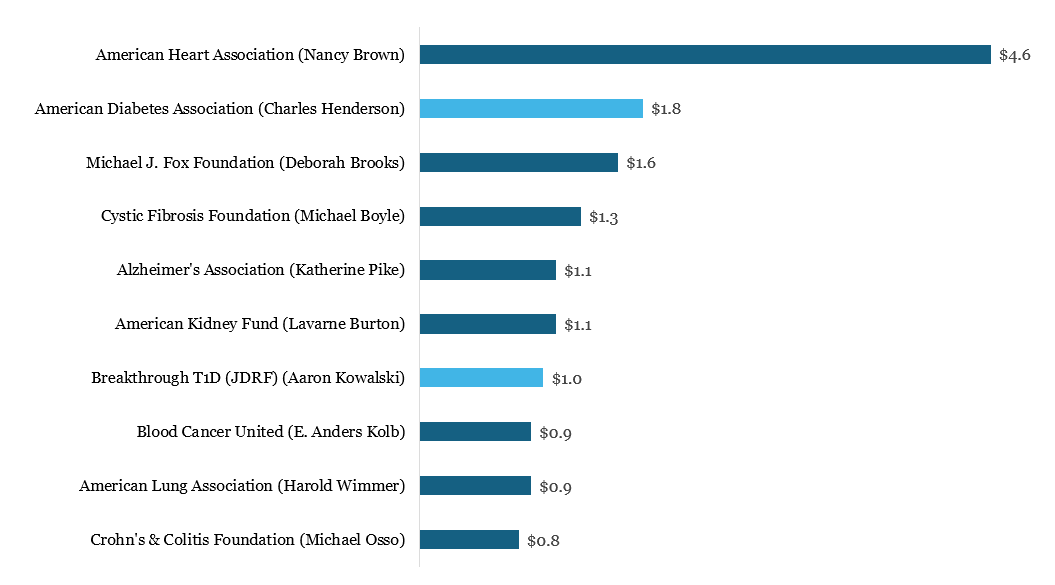
Henderson's compensation increased by a dramatic 40% from $1.3 million in FY24 and is now more than three times that of ADA’s next-highest-paid executive. 86% of his compensation was guaranteed and not linked to performance.
Charles Henderson’s compensation represents approximately 1.1% of ADA’s $163 million in revenue. By comparison, the highest-paid CEO on the list, Nancy Brown of the American Heart Association (AHA), received compensation equal to 0.4% of the AHA’s $1.07 billion in revenue. More significantly, 71% of Brown’s compensation was performance-based versus 14% for Henderson.
Aaron Kowalski received approximately 0.3% of Breakthrough T1D’s $302 million in revenue. 28% of his compensation was performance-based. In this case, CEO compensation as a percent of revenue is in line with most other large disease-focused nonprofit organizations on the list (see appendix A).
T1D Top 5 Executive Compensation
Breakthrough T1D
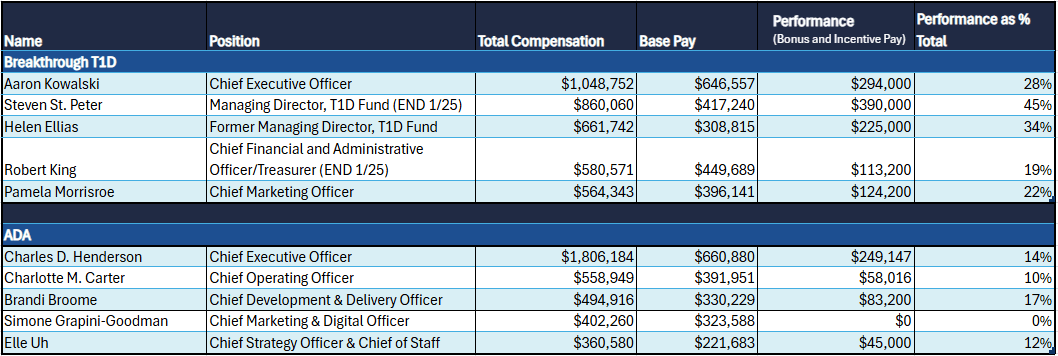
The five highest-paid Breakthrough T1D executives received a combined $3.7 million, or 1.2% of FY25 revenue. Consistent with prior years, fixed base salary accounted for most of their compensation (see appendix B).
The three highest-paid executives after the CEO are no longer with the organization, indicating a relatively high level of senior executive turnover. Two were Managing Directors of the T1D Fund, while the other was the CFO:
- Steven St. Peter, the second-highest-paid executive, received $860 thousand, of which 45% was performance-based.
- Helen Ellias, the third-highest-paid executive, received $662 thousand, of which 34% was performance-based.
- Robert King, the fourth-highest-paid executive, received $580 thousand, of which 19% was performance-based.
American Diabetes Association
The five highest-paid ADA executives received a combined $3.6 million, 2.2% of revenue. As in prior years, most of their compensation was fixed and guaranteed. Of ADA’s top five, four received an incentive bonus. Collectively, their incentive bonuses accounted for only 11% of the group’s average total compensation.
By far the biggest story from the ADA is the amount of executive pay in total and relative to revenue.
Recommendations
Performance-Based Pay Structure
Performance-based pay is granted only when measurable goals are achieved, unlike base pay, which is fixed regardless of achieving goals.
In most for-profit organizations, performance-based pay makes up most of the compensation executives receive. This works because it motivates the CEO to deliver tangible results that benefit the organization and advance the mission.
For nonprofits, adopting a performance-based pay structure could align the interests of executives and donor-shareholders, all of us who give, and establish clear accountability. We believe this would accelerate speed to a cure.
JDCA believes nonprofits should link executive compensation to advancing a cure—the universal mission of nearly all disease-focused nonprofits—so pay is driven by measurable results.
“Say on Pay” Model
Say on Pay is a practice that allows shareholders and other stakeholders to vote on executive compensation. It makes clear to executives that their pay depends on meeting defined goals, and it gives shareholders a strong voice.
Most nonprofits have resisted this practice. Donors serve as the shareholders of a nonprofit, yet they have no voice on compensation despite contributing millions of dollars each year.
Adopting Say on Pay would align nonprofits with their donors by linking executive compensation to donor priorities. CEOs would then have a clear incentive to focus on those priorities, which most likely reflect the mission itself: progress toward a cure.
Appendix A: 75 Chronic Disease Nonprofit CEOs Ranked by Total Compensation
Appendix B: Compensation of the Top Five ADA and Breakthrough T1D Executives, FY25